Showing posts with label Portuguese guitar. Show all posts

Thursday, August 11, 2022

THE ROOSTER OF BARCELOS


This cute little fella was a gift from a friend we made at a bar/restaurant in the Burgus Tribute and Design Hotel in Braga. We often walked there to have a glass of wine and a bowl of some of the most delicious pistachios ever and chat with the wait staff, Sara and Ricardo. Burgus also makes delicious omelets and a few times we had dinner there. The evenng before we left Braga, we walked again to Burgus to say goodbye. Sara wasn't in, but left this rooster with Ricardo as goodbye gift, and while I have it on the mantelpiece now in our furnitureless livingroom, eventually it will have pride of place on a special shelf when our shipping arrives. 

The Rooster of Barcelos is a famous folk tale in Portugal, and thanks to its fame, in almost any tourist shop, you can find dishtowels, potholders, statuettes, refrigerator magnets, whatever, all imprinted with the rooster. It has become an icon or symbol in Portugal.

Here is the folk tale: There are varying versions, but they all add up to the same story: (It is also told by one of the characters in my new mystery, Deadly Verse.) 

A man was passing through Barcelos, and stayed at an inn. In some versions, he is a Galician pilgrim on a pilgrimage to Santiago de Compostelo. In Barcelos, some silver was stolen, and the pilgrim - a stranger in town - became the suspect. He was arrested and condemned to hang. But he begged to be taken to the judge, and it so happened the judge was getting ready to eat a cooked rooster. The pilgrim, protesting his innocense, told the judge that the moment he was hung the dead rooster would begin to crow. Well, the judge lost his appetite, but didn't change the verdict. And, as the pilgrim predicted, the moment he was hung, the rooster stood up and began to crow. This made the judge realize his error, and he rushed to the gallows. As luck would have it, the noose had been tied with a defective knot and the pilgrim didn't hang after all. 

You may wonder about the strange shape of the rooster statue in this picture. It's in the shape of a Portuguese guitar, because Sara knows how much Rajan and I both love Fado, that distictive Portuguese song form like no other. In traditional Fado, the singer is accompanies by two musicians, one on acoustic guitar and one on Portuguese guitar. The Portuguese guitar has a distinctive sound similar to the sound of the strings on a Greek bouzouki, which we also love.) So this little guy has a double pleasure and sentimental value for us. 

Speaking of music, Monday evening we met our friends Alice and Bill at the Fox & Goose to hear some great playing (and singing). It was open mic night, hosted by two fabulous guitar players who took us back to music of the 60s & 70s, bluegrass, country western, blues, folk, folk rock. Other people often come to sing and play, too. The woman you see in the photo on the right sings and plays a terrific violin.


How about you? Do you have any favorite folk tales to share? Do you have a favorite kind of music you like to listen to? Is there an open mic evening in your area?


Saturday, October 7, 2017

An Evening of Fado, and More


Ever since I first heard Maria do Ceo sing Fado on a summer night four years ago, at Rectoral de Castillon, a "casa rural" in Galicia, I've been a fan, both of Maria do Ceo and of Fado. (You can read my post about it HERE )  

The following spring, 2014, when my husband and I went to Braga, Portugal for the first time, a friend at the hotel suggested other famous Fado singers we should hear — Mariza, Amalia, Anna Moura — and we've both been hooked on Fado ever since.

So it was our special good fortune that fall to meet a Fadista in Braga, Mariza da Luz, and   
become friends with her. Since then we try to see her perform every time we go to Braga. (We had started going to Braga for research on a mystery I've written that is set in Braga.)


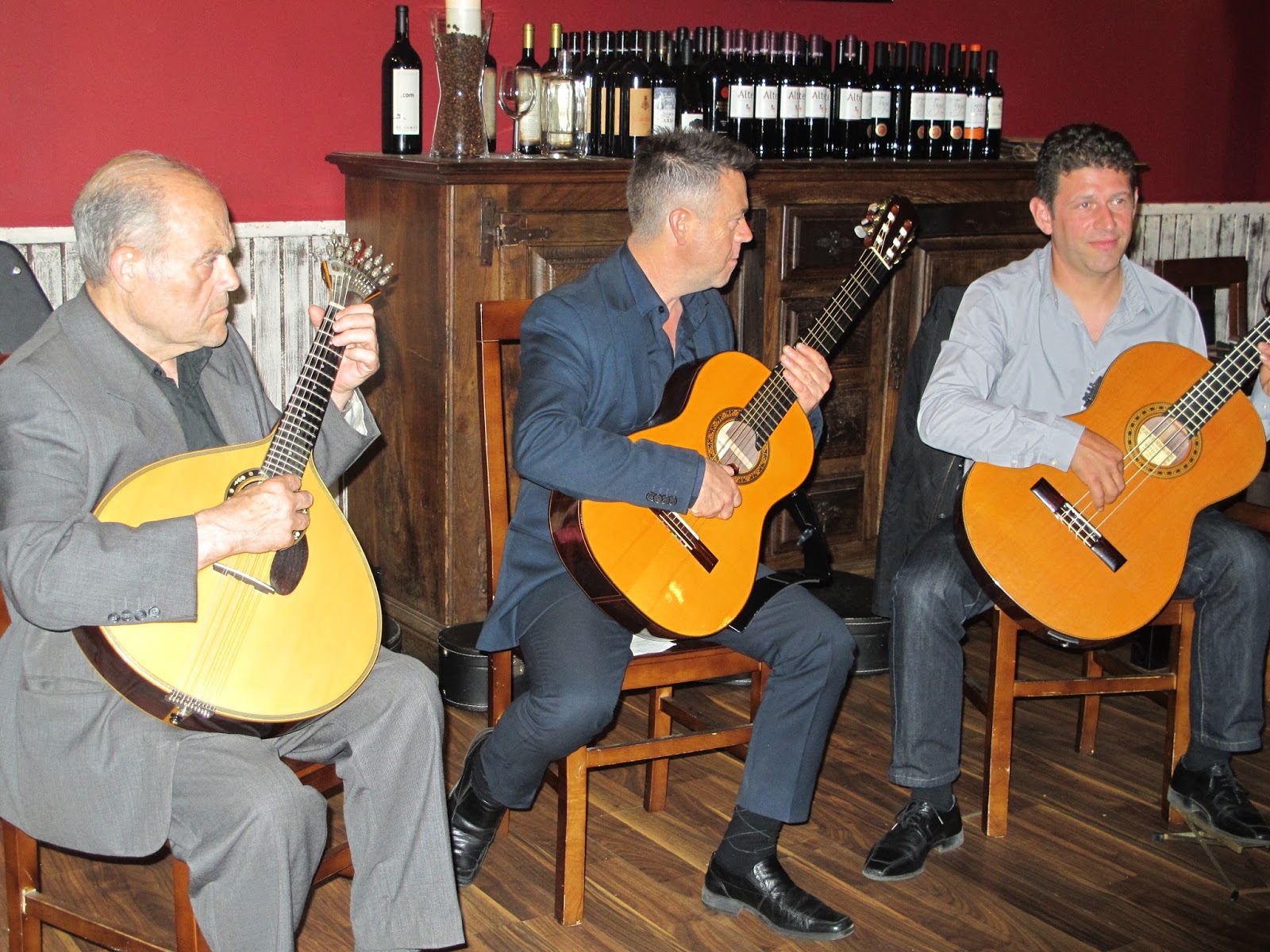
Last week was no exception. Originally we had heard her sing at a restaurant, but Saturday we heard her and several others sing at a dinner put on by a Fado Association. As you can see, Fado is emotional and expressive, pulling a listener into a different world — and the singer, as well. Traditionally a fadista is accompanies by two guitars: an acoustical guitar and a twelve-string  Portuguese guitar (which somewhat resembles a bouzouki with its bowl-shape, although they are not identical by any means.)


Add caption


Not every member of the association is interested in Fado as a career; some are simply aficionados who took turns singing during the dinner. All of the voices were good, though, and the ambience of the evening was full of hearty good will and a deep love of Fado. (Nearly everyone in the room could sing the chorus of every single song.)  


I'm always comparing Fado to opera, especially the serious/somber Fado, the Fado that dwells on fate and thwarted destiny. If you were to take one of the serious operas  and cram the essence of it into one aria, you'd have the depth of emotion and the lyricism of Fado.
But, like opera, Fado has a comic counterpart as well, and the gentleman at the far right in the top row sings these humorous Fados (although, as our friend, Marisa, pointed out, they often have a subtle serious overtone as well, inspiring the sort of chuckle that can fade with too much thought.)
                 
                  Too soon, it was over. At the end of the evening, all the singers gathered for final applause and photos.


Meanwhile, earlier in the day, a young man at Centésima Página, the bookstore/eatery we love to visit, told us a great deal about well-known fado singers and the history of Fado. He introduced us to a CD of Fadistas from Coimbra, a city famous for its male fadistas. The recordings are old and "tinny", in that they were recorded back in 1928, 1929, 1930. But all of the voices shine, their  power and expressiveness evident.  I've mentioned that Fado reminds me of opera, and this CD showed the operatic power of their voices. We left the store with a bag of CDs to enrich our musical library. As I have said before, I can never leave a bookstore empty-handed (even if it's CDs).

                                         Centésima Página - "The 100th Page"
                                  You can see the "100" in the window)

How about you? Do you like Fado? Opera? What is your favorite music? Do you love book stores and music stores?


Wednesday, June 24, 2015

An Evening of Fado and a Fadista to Remember

 One of the great traditions of Portugal is the unique music called Fado. I first heard Fado two years ago in Galicia, when Maria do Ceo sang at a  restaurant in a casa rural. (I blogged about her singing HERE and HERE.)

My next Fado discovery was the great Fadista, Marisa da Luz, in Braga, Portugal.


By the time my husband and I went to Braga last year to do research on a book I am writing, we were both hooked on Fado, and we especially wanted to find a place where we could hear it. We lucked out! Mercado das Tapas offers Fado every Thursday evening and a wonderful selection of tapas, as well as that great potato and kale soup called Caldo Verde.

At Mercado das Tapas, various Fadistas perform, but when we went last year we were fortunate to hear Marisa da Luz. We liked her so much that, when we knew we were going again early this month, we requested her. There are many things that make her such a good Fadista: To begin with, she has a beautiful voice with quite a range. But she also pours such feeling into her songs, they wring your heart.


There are cheerful songs in Fado, but the majority of songs deal with life, one's soul, fate. Fado has been called the Portuguese equivalent of American Blues, and to some extent, that's true. But to me the melodies are more complex and take one by surprise. Some tell a story. Some are philosophical. Some simply express the sadness of loss at a high level of poetry. Some of the lyrics are taken, in fact, from the poetry of one of Portugal's greatest and most mystical poets, Fernando Pessoa. Normally a Fadista is accompanied by two or three musicians. One or two will play guitar, and the remaining one will play a Portuguese guitar, which sounds very much like a mandolin.

Add caption

Add caption


Fado is an art form like no other, and Marisa da Luz's voice and delivery rise to the demands of it. We predict that she is a rising star Fado lovers will hear of more and more.

Elegant and dramatic
She was the main singer of the evening, but three men took turns singing Fado, too, as many Fadistas are men, and this seems to be tradition.

Beautiful voice.


Great feeling
The humorous one.
As it turned out, it was Marisa da Luz's birthday, and she was celebrating it with her friends and family. Graciously she shared some champagne with us, and she let us take pictures of the party, as well as a couple of pictures with them! And with her! A very cordial, down to earth lady.
The woman behind me on your
right is one of the owners.

She gave us champagne!

A wonderful group of people as
you can see.


I was really honored.

Thank you, Marisa da Luz, for an inspiring evening full of wonderful song.


Next week: Some of our favorite places in Braga, and a wonderful tour guide.

Meanwhile, what is your favorite music to listen to? Have you heard Fado? If so, do you like it?