Showing posts with label Fadista. Show all posts

Wednesday, June 24, 2015

An Evening of Fado and a Fadista to Remember

 One of the great traditions of Portugal is the unique music called Fado. I first heard Fado two years ago in Galicia, when Maria do Ceo sang at a  restaurant in a casa rural. (I blogged about her singing HERE and HERE.)

My next Fado discovery was the great Fadista, Marisa da Luz, in Braga, Portugal.


By the time my husband and I went to Braga last year to do research on a book I am writing, we were both hooked on Fado, and we especially wanted to find a place where we could hear it. We lucked out! Mercado das Tapas offers Fado every Thursday evening and a wonderful selection of tapas, as well as that great potato and kale soup called Caldo Verde.

At Mercado das Tapas, various Fadistas perform, but when we went last year we were fortunate to hear Marisa da Luz. We liked her so much that, when we knew we were going again early this month, we requested her. There are many things that make her such a good Fadista: To begin with, she has a beautiful voice with quite a range. But she also pours such feeling into her songs, they wring your heart.


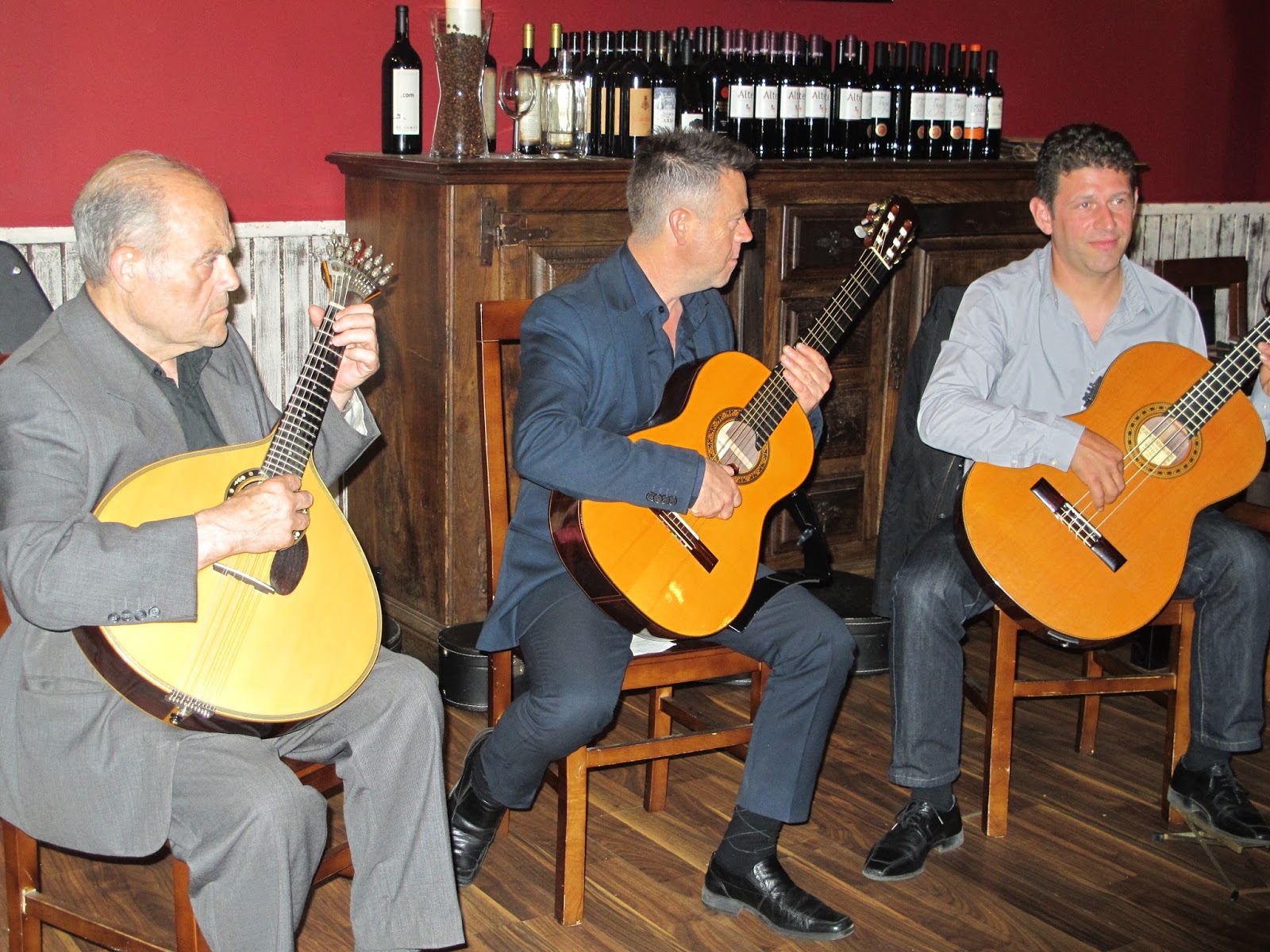
There are cheerful songs in Fado, but the majority of songs deal with life, one's soul, fate. Fado has been called the Portuguese equivalent of American Blues, and to some extent, that's true. But to me the melodies are more complex and take one by surprise. Some tell a story. Some are philosophical. Some simply express the sadness of loss at a high level of poetry. Some of the lyrics are taken, in fact, from the poetry of one of Portugal's greatest and most mystical poets, Fernando Pessoa. Normally a Fadista is accompanied by two or three musicians. One or two will play guitar, and the remaining one will play a Portuguese guitar, which sounds very much like a mandolin.

Add caption

Add caption


Fado is an art form like no other, and Marisa da Luz's voice and delivery rise to the demands of it. We predict that she is a rising star Fado lovers will hear of more and more.

Elegant and dramatic
She was the main singer of the evening, but three men took turns singing Fado, too, as many Fadistas are men, and this seems to be tradition.

Beautiful voice.


Great feeling
The humorous one.
As it turned out, it was Marisa da Luz's birthday, and she was celebrating it with her friends and family. Graciously she shared some champagne with us, and she let us take pictures of the party, as well as a couple of pictures with them! And with her! A very cordial, down to earth lady.
The woman behind me on your
right is one of the owners.

She gave us champagne!

A wonderful group of people as
you can see.


I was really honored.

Thank you, Marisa da Luz, for an inspiring evening full of wonderful song.


Next week: Some of our favorite places in Braga, and a wonderful tour guide.

Meanwhile, what is your favorite music to listen to? Have you heard Fado? If so, do you like it?

Friday, August 2, 2013

Fado - An Unforgettable Night In Galicia, Spain

Back to my recent trip to Galicia, Spain:


One evening in particular stands out. It was the 24th of June, the night that the moon was so much closer than usual to earth, a good setting for the music I heard that night, a music that pulled emotions closer to the surface of one's heart -- that haunting genre of singing born in Portugal, Fado.


I sat with friends, David and Terry and Marta at the Rectoral de Castillon, a lovely casa rural near Goian and Ferreira that offers fine meals in its unique restaurant as well as lodgings for travelers. My husband and I have eaten there several times with Terri and David. This night, Rajan was home in California, taking care of our ailing dog. Terri and David picked me up, and Marta joined us, for a dinner celebrating Rectoral de Castillon's tenth year in operation. (More information about Rectoral de Castillon can be found below.) But here is a picture of how the tables are set up inside: 


A delicious meal served inside was followed by an evening of song outside.

Space heaters warmed the courtyard where after dinner tables had been set up. The walkway above the stairs to the courtyard had become a stage with lights and amplifiers and a microphone. Two men sat on either side, one with a guitar, the other with a mandolin. Night had fallen (dinners are late in Spain). The stage was bright. The audience was expectant. The fadista, María do Ceo -- a petite woman with doe eyes and a demure smile -- quietly walked to the microphone. She wore a long black gown. A simple black shawl draped over her shoulders. She paused. The audience quieted. She began to sing. 

This was the first time I heard fado, although a writer friend of mine has talked enthusiastically about it for years. I had thought it merely the “popular” music of another country, much like the popular music that dominates our top ten and top forty charts in America. Nice. Cool. Etc. But this was so much more: The pathos in the voice, the phrasing, the nuances, the melody line—they all reach out and transport a listener to another time and place.

Fado is about fate, destiny, about how things can go wrong and what one is left with. Fado is a particular genre of Portugese song that dates back in record to the 1800s, but even earlier by word of mouth. Its roots are in cities, most notably Porto, Lisbon, and Coimbra. It became popular originally among the poor and unfortunate, was sung on the streets and in taverns. There are hints of a Moorish influence. (Portugal has always been a crossroads of cultures.) The music is characteristically sad, nostalgic, full of longing, recalling star-crossed dreams, lost loves, bitter-sweet memories. Its deepest roots reach into the human heart. The lyrics have evolved in modern times into a complex structure as well. Today's Fado is as soulful as the blues, as poetic as a sonnet. It's a genre like no other.


Originally from Porto, Portugal, María do Ceo is very popular in Galicia. (When I mention to my neighbors, Eva and Monolo, that I had heard a wonderful Fado singer, they immediately said, in unison, “¡Maria do Ceo!”) She is also famous throughout Europe and South America. Her voice is particularly expressive, and even though I couldn’t understand a word of Portuguese, I was deeply moved during every song. In the chill air, under a star-glittered sky, her voice told story after story. 
Here are two examples of her performances on You Tube:
Lela  and  Negra sombra  

                                                                                                                                                               You can also visit her bandpage on Facebook and listen to three more songs to get an idea of the full range of her artistry. The disc shown on this page is the disc I bought and brought home for my husband to hear, and he is now a fan.  


Visit, too, Rectoral de Castillon, which hosted this wonderful event:
The hosts are charming, the atmosphere is elegant, the prices are reasonable, and the food is delicious.


You can contact them and like them at Facebook

You can also learn more about their lodging accommodations on Trip Advisor

And you can learn more about Fado here and HERE.

What about you? Do you have a favorite musical form that touches you like no other? If you listened to the above songs, did one move you more than the others? If so, which one?