Tuesday, October 1, 2013

One Potato, Two Potato, Three Potato, Four . . .

Last year, Miguel (our neighbor with the sheep) asked if he could use the lower half of our field to plant some potatoes. We said, "Sure!" We don't use it, and all our neighbors give us of their bounty. It seems the very least we can do. So, in spring and summer, on separate trips (due to our ailing, aged dog who needed tending at home), we saw ruffled rows of green leaves in what formerly had been a weed patch. Other neighbors told us the woman who lived here before us grew enormous tomatoes in that field. Still, imagine our surprise when the field yielded potatoes like this!

About two weeks ago, we looked out our galeria window and saw Antonio, Maria Elena, and Miguel, all working together to harvest the potatoes.
 Antonio was using his tractor. (Neighbors help each other out here; we often see Miguel at Antonio's farm, helping to plant or harvest, depending on the season.) Miguel is on flatbed in the picture below. And the last picture shows what the eventual harvest looked like. All this from such a small field. They obviously know what they are doing. When they saw us watching, Miguel hopped down and loaded up a sack of giant potatoes for us, and we've been eating them ever since.


This coming week-end will be the grape harvest, or vendimia, for our village. The week-end varies from village to village, depending on a variety of factors. (Our English friends in Canabal have been growing grapes, and they harvested theirs a week ago.) As with the potatoes, friends and neighbors help each other out. All of them will make their own wine and store it in vats in their bodegas.


What starts out looking like this:


Ends up looking like this:

The first time Miguel brought us a two-liter coke bottle filled to the brim, we thanked him, but after he left, we wondered how to ever tell him that we don't drink Coca Cola? Then we noticed: that coke looked a little purplish. We unscrewed the cap, and, sure enough, it was a generous helping of his home-made wine. The home-made wine here is really "table wine". It's a bit on the tart side, but tasty enough, and it has a very low alchohol content, probably around 6% or 7% -- low enough that locals drink a hearty portion with their lunch or dinner or afternoon meriendas (snacks).

On another note, this trip we've been blessed with wonderful, sunny weather. On most trips in spring or fall, it rains at least once a day, all the colors glistening in the rain. But this time, we've been met with blue, cloudless skies and lush green fields and wooded hills. Although this week we've gone from this:


To this:
  Still, I find it beautiful. The mist and fog always make me turn to poetry. To me, this is Galicia at it's most beautiful.

What about you? Do you like sunshine best, or fog and mist? What weather most brings out the writer or photographer in you?


Wednesday, September 18, 2013

Return to Paradise


That's how it feels when we return to Galicia; more specifically, to our part of Galicia, the village of Trasulfe. We arrived in Santiago, Sunday, September 8th, around 5:30. Our friends, Terri & David picked us up at the airport and drove us to the village.

After opening the house, we went out for dinner, already on Spanish time,  at 9:00 p.m. or therabouts. (We were pretty sleepy.)  We went to Torre de Vilariño, a really charming cafe/bar/restaurant that we've been to often with our friends, and had champiñones al ajillo, mushrooms sauteed in olive oil, with garlic, salt, and red chile flakes, and truchas, small, delicious, crispy fried trout, served with Galician bread, which we really like so much. I don't have a current picture of Torre de Vilariño, but I will get one to post later.

The next morning, the first thing we did was walk down the hill  to greet all our neighbors, marveling again at the late summer/early fall scenery. You have to admit, those cows look pretty peaceful.


It wasn't long before our neighbors started giving us of their bounty. They are some of the most generous people we've ever met. The first morning Eva gave us eggs and home-made wine. Milagros gave us peppers and tomatoes. Miguel gave us potatoes and wine. A few days later, Eva gave us a huge bag of potatoes and another huge bag of peppers and tomatoes.  

You can see we are going to be cooking a lot of dishes with potatoes, tomatoes, and peppers. And we have had omelets a few times already. I do save some of the eggs to bake cakes for the neighbors in return. 

Later, we drove into Monforte, the nearest good-sized city that flanks the Parador, a former noble's castle, part of which was once a monastery. Now the castle is a hotel with restaurants and coffee shops, although its cathedral still is in regular use for worship. The building itself always grabs me. From any angle and any distance, to me it's very haunting.

We like to go to the indoor cafe/bar and have either coffee with a crescent tapa or a glass of wine with Spanish olives.

After that, we walked around the main plaza in town, happy that we had such beautiful weather. (When Rajan came in spring, while we were still taking turns with our dog, it rained every day except two.)


Over the week-end, Friday and Sunday, we were busy cooking Indian food for our British friends. Other days we worked at home and then in the evenings we went to the bench to chat with our neighbors. (They chat. We listen. We are getting better at understanding, though, until they switch to Gallego, just when we think we are getting the Castiliano. As a result, we've picked up a few Gallego words, too. )

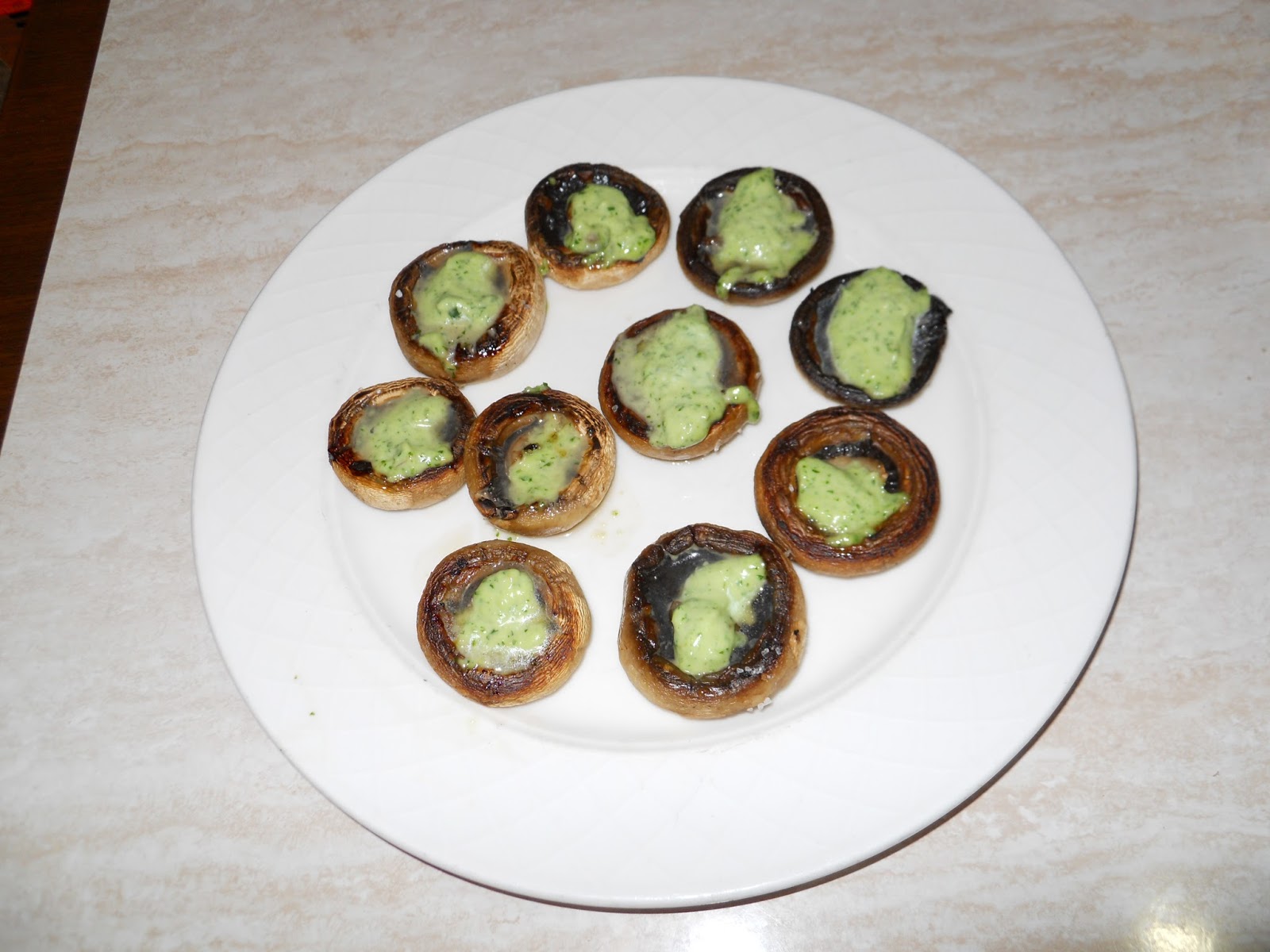
On Saturday we went into Monforte again, this time to have lunch at our favorite cafe/bar in town, Adega do Carlos. We don't have a good picture of Carlos to share, but you can go to his Facebook page and see how warm and welcoming he is as the owner. (Like his page, too!) We ordered two of our favorite racciones to eat with bread and wine:
Grilled Champiñones. The centers are
stuffed with garlic, parsley, maybe
 chopped mushroom stems and
 all ground together in a paste
with wine.


Pimientos de Padron, simply
sautéed in olive oil with salt.
So simple. So good!
You can see how much we liked them:

Afterwards I went to have my hair trimmed in a beauty shop in Monforte, called Tempus. I don't have my hair cut often, and never short, just trimmed. But I went this day especially because the grandaughter of our super neighbors, Eva and Manolo, is apprenticing at this shop. Her name is Lucia, and we've watched her grow from an early teen-ager, who would sweetly dance with her grandfather at the fiestas, into a young lady who drives and is planning a career. 

We thought she did a very good job. (Please pardon how dark the photo is.)

Sunday afternoon we encountered hunters on the road near Antonio and María Elena's farm, using walkie talkies and dogs to track the javalís (wild boars) attacking the wine grapes and rooting for potatoes. This is kinda javalí season. Monday, we learned either 8 or 9 had been killed, five of them near the farm above, the others here and there, but still in our area. No pictures to share, but Rajan is predicting they will show up on menus in the local restaurants.

On that happy note, I leave you for now, but I'll be back with more news and photos later.

Meanwhile, have you ever seen a live boar? (I haven't yet.) What is your favorite snack food? (Racciones always seem like snack food to me.) And do any of you have a good potato recipe?


Friday, September 6, 2013

On Our Way Tomorrow

By the time you read this, we will be on our way to Galicia, Spain, to the village and the people that have stolen our hearts. It's a long trip. But stay tuned. I'll be posting about our new ventures soon.

Saturday, August 31, 2013

Book Review: Goodnight, Mr. Holmes

Please check out my book review of Goodnight, Mr. Holmes, by Carole Nelson Douglas. It's on my other blog: Victorian Scribbles, and features Irene Adler, the only woman to ever outwit Sherlock Holmes. I posted it there, along with an earlier review, Claude and Camille, a Novel of Monet, by Stephanie Cowell, because both books take place during the Victorian Era/ Belle Époque Era, which is the focus of my Victorian Scribbles blog.

Enjoy both reviews. If you like historical novels, these books are for you!

Friday, August 2, 2013

Fado - An Unforgettable Night In Galicia, Spain

Back to my recent trip to Galicia, Spain:


One evening in particular stands out. It was the 24th of June, the night that the moon was so much closer than usual to earth, a good setting for the music I heard that night, a music that pulled emotions closer to the surface of one's heart -- that haunting genre of singing born in Portugal, Fado.


I sat with friends, David and Terry and Marta at the Rectoral de Castillon, a lovely casa rural near Goian and Ferreira that offers fine meals in its unique restaurant as well as lodgings for travelers. My husband and I have eaten there several times with Terri and David. This night, Rajan was home in California, taking care of our ailing dog. Terri and David picked me up, and Marta joined us, for a dinner celebrating Rectoral de Castillon's tenth year in operation. (More information about Rectoral de Castillon can be found below.) But here is a picture of how the tables are set up inside: 


A delicious meal served inside was followed by an evening of song outside.

Space heaters warmed the courtyard where after dinner tables had been set up. The walkway above the stairs to the courtyard had become a stage with lights and amplifiers and a microphone. Two men sat on either side, one with a guitar, the other with a mandolin. Night had fallen (dinners are late in Spain). The stage was bright. The audience was expectant. The fadista, María do Ceo -- a petite woman with doe eyes and a demure smile -- quietly walked to the microphone. She wore a long black gown. A simple black shawl draped over her shoulders. She paused. The audience quieted. She began to sing. 

This was the first time I heard fado, although a writer friend of mine has talked enthusiastically about it for years. I had thought it merely the “popular” music of another country, much like the popular music that dominates our top ten and top forty charts in America. Nice. Cool. Etc. But this was so much more: The pathos in the voice, the phrasing, the nuances, the melody line—they all reach out and transport a listener to another time and place.

Fado is about fate, destiny, about how things can go wrong and what one is left with. Fado is a particular genre of Portugese song that dates back in record to the 1800s, but even earlier by word of mouth. Its roots are in cities, most notably Porto, Lisbon, and Coimbra. It became popular originally among the poor and unfortunate, was sung on the streets and in taverns. There are hints of a Moorish influence. (Portugal has always been a crossroads of cultures.) The music is characteristically sad, nostalgic, full of longing, recalling star-crossed dreams, lost loves, bitter-sweet memories. Its deepest roots reach into the human heart. The lyrics have evolved in modern times into a complex structure as well. Today's Fado is as soulful as the blues, as poetic as a sonnet. It's a genre like no other.


Originally from Porto, Portugal, María do Ceo is very popular in Galicia. (When I mention to my neighbors, Eva and Monolo, that I had heard a wonderful Fado singer, they immediately said, in unison, “¡Maria do Ceo!”) She is also famous throughout Europe and South America. Her voice is particularly expressive, and even though I couldn’t understand a word of Portuguese, I was deeply moved during every song. In the chill air, under a star-glittered sky, her voice told story after story. 
Here are two examples of her performances on You Tube:
Lela  and  Negra sombra  

                                                                                                                                                               You can also visit her bandpage on Facebook and listen to three more songs to get an idea of the full range of her artistry. The disc shown on this page is the disc I bought and brought home for my husband to hear, and he is now a fan.  


Visit, too, Rectoral de Castillon, which hosted this wonderful event:
The hosts are charming, the atmosphere is elegant, the prices are reasonable, and the food is delicious.


You can contact them and like them at Facebook

You can also learn more about their lodging accommodations on Trip Advisor

And you can learn more about Fado here and HERE.

What about you? Do you have a favorite musical form that touches you like no other? If you listened to the above songs, did one move you more than the others? If so, which one?


Sunday, July 14, 2013

Mira's Diary - A Satifying Way to Travel

I had planned to post more about the Spain trip (which I will in due course), but when I arrived home close to midnight nearly two weeks ago, I came down with a summer cold that my husband caught a few days later. The upside of being sick with a cold is that you are sick enough to hold off on work, but not too sick to read! So I read indeed, and with great pleasure. One of these pleasures was Mira's Diary -- Home Sweet Rome.

                                       
Mira's Diary is the charming time travel mystery series by Marissa Moss.
I came across Book I, Lost In Paris, last year and wrote a review of it for Sacramento/San Francisco Book Review. You can read the review of Lost in Paris HERE.

The Paris adventure left me waiting for Mira's next one, and Home Sweet Rome does not disappoint.

The over-all frame is this: Mira's mother, a time traveler, is somewhere in the past, trying to avert something terrible happening in the future. She shifts around to various historical eras -- and she can't tell the family all the details, but she leaves postcards as clues as to her next destination. Mira's father -- who knows his wife time travels -- is a renowned photographer on a fellowship to photograph modern wonders of the world. This gives the family the excuse they need to go to the cities mentioned in the postcards. As it turns out, Mira is a time traveler, too, and her mother needs her help in piecing together the various cases that all seem part of the larger mystery.

This time, Mira lands in 16th century Rome during the Inquisition, when the Church is persecuting independent scientific thinkers. Dressed as a boy named Marco, she first works in the kitchen of the Del Monte palazzo. Another servant named Giovanni befriends her and introduces her to his master, none other than the painter Caravaggio. Caravaggio arranges for her to meet Del Monte in person and Mira -- as Marco-- is soon put to work as a scribe, copying letters and reports and cataloguing books for the Cardinal del Monte. Soon she finds her work is connected to the heretical ideas (in those days) of Giordano Bruno, a mathemetician and scientist. (I will not be a spoiler and reveal how these are linked.)

The story is fast paced, the settings wonderfully realized, pulling a reader into a personal experience of ancient architecture and well-known paintings. This is like a free trip to 16th century Rome—a tour of famous buildings, without a tedious tour guide. One of the delights of a series like this is that you can learn about history in ways that aren't a bit dull. Young people will like this book for the adventure, and it's a great introduction to some of the science we take for granted today.

Meanwhile . . . there are the Watchers. The Watchers are a group of "time police" who punish anyone trying to tamper with history. They are trying to hunt down Mira's mother -- and Mira, too, whenever she shows up out of her own time. Mira manages to complete her part of the mission involving Bruno; but her mother hasn't returned to the present, and the overriding mystery remains with an aura of worry for Mira's family. Mira's father believes Mother's ultimate mission involves something in the future that threatens them as a family.

One can only wait for Book Three to get a closer look at what that threat may be, and to enjoy another free trip to a historical locale.

Author, Marissa Moss

Contact information:

Marissa Moss's Website

Facebook

Author Page on Amazon


How about you? Do you like time travel stories? Historical novels? Mysteries? Stories involving art? What are some of your favorite reads? Why?

Monday, June 24, 2013

Three weeks and a day in Galicia


Beautiful Galicia
I certainly expected to be posting about this trip long before now: I arrived Sunday, June 9th, and I'll be leaving Galicia exactly a week from today (a day earlier from Trasulfe, as the plane leaves early in the morning, and I have no desire for a trip in the middle of the night to arrive at the Santiago airport in time for the flight).

There's a reason I haven't found time to blog. My husband stayed home on this trip (as I did in April) to take care of our old and ailing dog. Because I'm alone, I was busy opening the house (and this Sunday will be busy closing it). Because I'm alone, all our friends have been inviting me places. Because I'm alone, I was busy shopping and cooking for company. Because I'm alone, I've been the one driving everywhere, and managed to get lost twice, ending up in towns I didn't truly plan to visit at the time.


But, it's all been a grand experience. And, since I am alone, roadside walks take on a special significance. So I thought I'd share with you the wild flowers I've been talking about on Facebook, where I've been sharing short snippets of the trip. (Do come and visit me there:   on my timeline, and also on my author page  )

One day I walked down the winding road to the carretera snapping pictures of all the wildflowers I saw. They are abundant this time of the year (we usually come in spring or fall); some of them are familiar, some of them I've only read about but was able to look up, and some of them are still mystery plants that maybe you can help identify for me. Here they are:
Wild foxglove, and all in
this lovely color. All along
roadsides. 
Small white daisies -- and
a mysterious purple flower
I've never seen. Have you?
Wild broom everywhere;
really a bush more than a
flower, filling the landscape.


I thought these were
dandelions, but a closer
look makes me think not.
Maybe yellow daisies?
Purple thistles -- but so small!


Queen Anne's lace. 


I also have seen lots of yellow buttercups, pink and white primroses, and blue forget-me-nots with tiny yellow centers, but I haven't taken any pictures of them. 

Of course, ferns aren't flowers,
but these are abundant on
roadsides and in fields.
This wild elderberry bush
is growing just a few feet
away from our house. 

But what is this mystery flower?
Maybe the sheep could tell us if they weren't so busy having their mid-day meal:

If YOU know what that flower is, let me know.

Hasta luego.