Thursday, January 3, 2013

Back to the Iberian Peninsula!


Top left corner is Galicia.
It's been such a busy time since we returned from Galicia at the end of October. I only managed one post on return, and then there was the announcement of my husband's photo website and contest, announcement of the winner, a friend's book launch, a family reunion in Raleigh, North Carolina, another friend's book announcement, and then Christmas (which was just lovely but where went the time?) All the while Galicia has been on my mind, but I've been pouring my responses to it into poetry. So it's nice to be back to blogging about the place we love so much.

Today's post, however, is about a trip we took with our friends, David and Terri, to Porto, or "O Porto", in Portugal. Portugal is directly south from Galicia and is like a continuation in many ways. If you look on a map, you can see that one flows into the other, and, indeed, Gallego and Portuguese are "sister languages". For the most part, a speaker of one can understand a speaker of the other with very little difficulty.

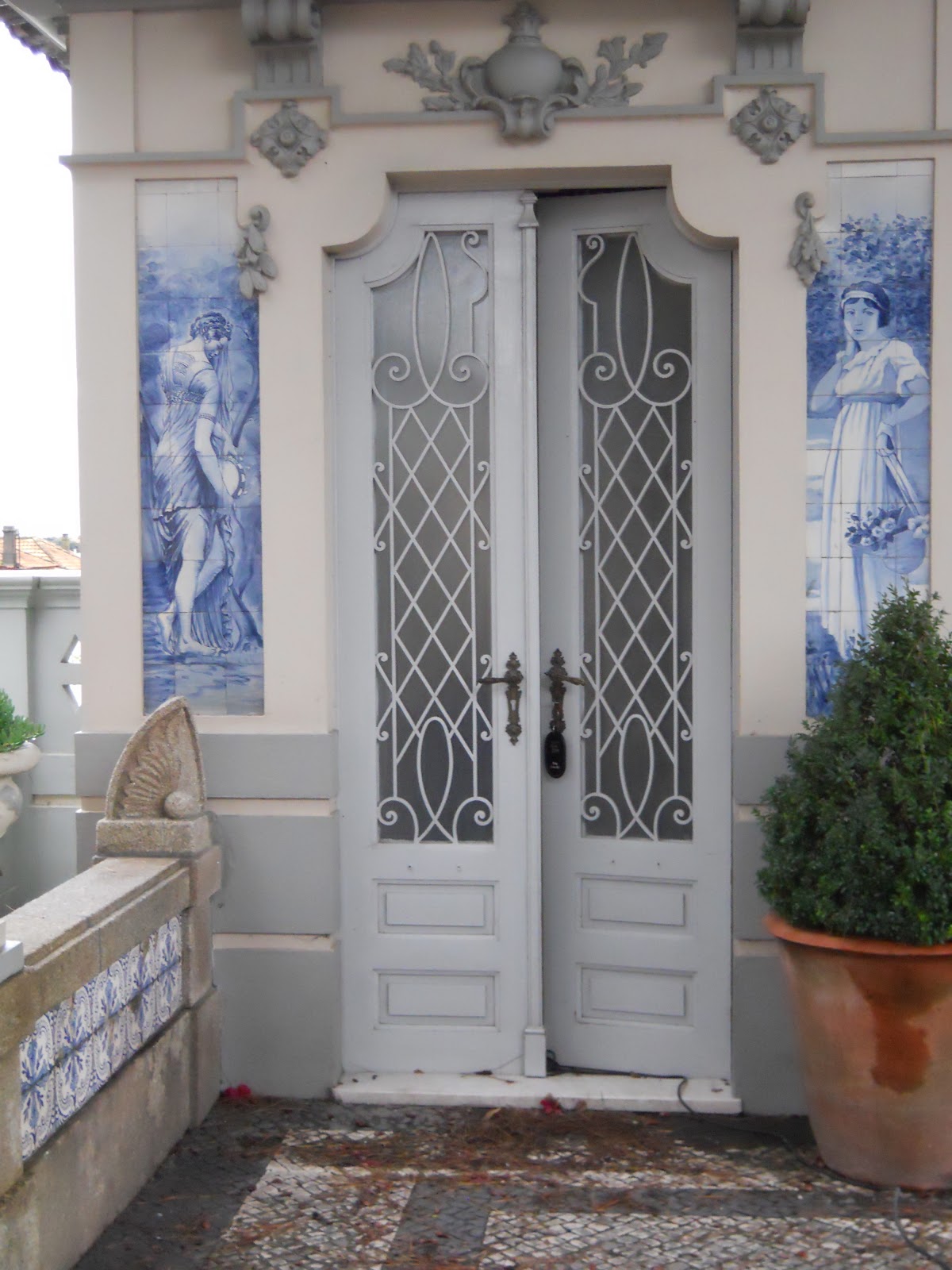
But when I think of Porto, I remember tiled walls, a feature, I have to say, of any Portuguese city. (We went to a walled border town, Valenca, a few years ago, and were struck at that time, too, by the many artistically tiled walls.) Along every street, whether old or restored, buildings gleamed with colorful tiles. We stayed for two nights, and the day we arrived the weather was overcast, but that made no difference. In sun or mist or rain, Porto is a beautiful and colorful city.


We stayed at what a brochure described as a castle, appropriately named Castelo de Santa Catarina. We've also been told it was a mansion built by someone from Argentina, who later returned to South America. It's a beautiful place, as you can see from the pictures below. There is a central crenelated tower that certainly epitomizes a castle tower,
and also a separate chapel (which was typical of castles in olden days), but the rest of Castelo de Santa Catarina branches out in wings with tiled walls, and gardens at several levels. My husband and I both went crazy with the cameras. Below is just a sampler of what this amazing place looked like!


Neither Terri nor I could resist the opportunity in one of the gardens to sit with ancient pharaohs:

                         
(Do you get the feeling they're ignoring us, though? That's just like those ancient pharaohs!)

The first day, despite overcast weather, we headed down to the river (the Río Douro), where the cafés and shops are. It was a nice walk from our lodgings, ever downward toward the river, and finally down a flight of stairs to the river level and the main wharf area—a convivial sight to say the least, flocking with tourists. Lots of handmade items in some shops. I picked up a few souvenirs there to bring back.


Before returning to Castelo de Santa Catarina, we had a really fabulous dinner at a restaurant close to our lodgings: It was an unbelievable meal, enhanced greatly by one of the servers who had a truly funny sense of humor. Here we are, having a grand old time at O Forno:

O Forno 
                                         Rajan, the server, Terri, and David

Me, Terri, David, & Rajan
After our meal we returned to Castelo de Santa Catarina: And another artistic experience greeted my husband and myself:


Our bedroom.
Our bathroom.
The breakfast room next morning.
And with that, I bid you goodnight for now. Coming up: A wine shop, a river cruise, a school, and a fond farewell to what we will always remember as "The City of Tiles."

Meanwhile, is there anything else you would especially like to know about Porto? I'm so enamored of the trip I'd be more than happy to look it up.


Wednesday, December 12, 2012

A Miracle Under the Christmas Tree


         I am pleased to announce the exciting news that Rosi Hollinbeck's Christmas memoir, Christmas Without Snow, is included in the new Christmas anthology by Jennifer Basye Sander, A Miracle Under the Christmas Tree, along with many other wonderful stories. This book will make will make great holiday reading. Order information is at the bottom of this post.

Rosi also hosts a wonderful blog called The Write Stuff which you can read by clicking here. (It's also shown again at the bottom of this post.) A little about her story:

CHRISTMAS WITHOUT SNOW by Rosi Hollinbeck

Living in Minnesota has some drawbacks: the sweltering dog days of August filled with mosquitoes the size of Buicks, and Februarys that seem to freeze even time.  But one of the true joys of being a Minnesotan is being there at Christmastime.  It just seems so right.  Minnesota is a Christmas kind of place. Cheeks and nose-tips redden in crisp, cold air. Soft, fresh snow nearly always blankets the ground on Christmas mornings. Frost covers everything turning trees and bushes in jeweled ice sculptures. The daytime sky is such a pure, hard blue, it hurts to look at it, and the sun casts purple shadows across the snow. The sweet smell of burning hardwood permeates the air through the long evenings. . .   


About Rosi Hollinbeck:
Rosi lives in Roseville, California, just east of Sacramento. She is active in the Society of Childrens Book Writers and Illustrators as well as the California Writers Club. She has work in up-coming issues of Highlights and Highlights High Five magazines. Her historical short story, Helen’s Home Run, won first place in the 2011 Foster City International Writers Contest Children’s Division. Her middle-grade novel, The Incredible Journey of Freddy J., was a finalist in the Grace Notes Discovering the Undiscovered contest. She writes book reviews regularly for the Sacramento Book Review and on her blog. You can find out more about her at her blog at http://rosihollinbeckthewritestuff.blogspot.com.  

Purchase Links: A Miracle Under the Christmas Tree is available from Barnes and Noble as a paperback or Nook book or from Amazon as a paperback or Kindle book. Here are the links:


Monday, December 3, 2012

Today is Launch Day for MAKE BELIEVE, the Story Collection Where You Can Read Lynda Young's Short Story: BIRTHRIGHT


Lynda R. Young’s short story titled Birthright has been published by J. Taylor Publishing in the Make Believe anthology launched TODAY! Virtual cake for everyone!! Make Believe is currently available in e-book format and includes Paranormal Romance and Fantasy stories inspired by the image on the cover. This will make great holiday reading. 


Birthright by Lynda R. Young
Christa can mask the pain and hide the scars, but running from a birthright is impossible.

She’s tried to escape her grief by fleeing to a small town in Florida. Much to her frustration, the locals think they recognize her even though she's never been there before. To make things worse, a man named Jack spouts outrageous theories about her.

Both spur Christa to bolt, to start fresh yet again, but there’s something about Jack that intrigues her enough to stay. The only problem? Someone else wants her to leave, and they won’t stop until she’s dead. 

Go this minute to the J. Tayor Publishing Make Believe  website HERE to read blurbs about all the stories in this wonderful collection, as well as how to order it.

About Lynda R. Young:
Lynda R. Young lives in Sydney, Australia, with her sweetheart of a husband who is her rock, and a cat who believes world domination starts in the home. She writes speculative short stories and is currently writing novels for young adults. In her spare time she also dabbles in photography and all things creative. You can find her here: Blog, Twitter, Facebook, Goodreads  


Saturday, December 1, 2012

And the Winner Is . . .

The winner in the recent photo contest for a free print from my husband's Galicia Gallery is:

JaNay Brown-Wood. Congratulations, JaNay!

Friday, November 9, 2012

My Husband's Photography Website & a Contest

Monastery

Ribeira Sacra Doade

I am pleased to announce my husband's new website, VARADANARTFOTO.COM

featuring his black and white art photographs.


Many of you have commented on the photographs of Galicia posted in my blog. Most of them were done by my husband, Rajan Varadan, whose specialty is actually black and white photography. Ever since we’ve been going to Galicia, he’s been captivated by the beautiful old stone buildings and walls (some of them in ruins, and some in beautiful repair). And the countryside especially offers beauty because of the various textures in the landscape (vineyards, forests, pastures, and rising mist). 
A Small Vineyard


For about six years he made calendars featuring 12 of the particular year’s best. Then last summer, our friends in Galicia, Terri and David Anderson, arranged for an exhibition of those 60 photos at the Concello in Ferreira, a town near where we live. We weren’t able to be there, as we’d returned from a trip in the spring, but they sent pictures of the exhibition, and I blogged about it in my May 28th post this year (you can click on it at the right margin.)


Now he has started an online gallery with photos to share: So far he only has the Galicia gallery up, but in the future, he will have a California gallery and a gallery with photos of places in India. (He’s from India, and is especially enamored of the Belur Halibid temples with their many exquisite sculptures and carvings.)


Sheep Grazing in Bramble

At present he is featuring 62 black and white photographs of Galicia, many of which were not in the show. The website is VARADANARTFOTO.COM  When you go to the site, click first “Portfolio” and then “Galicia”.  


A Path through the Village


The Gathering

Scroll through all the photos, each of which has a name and number.
The latter is important, because we are running a contest! Whoever wins gets an 8-1/2 by 11 print of their favorite photo free, including free shipping -- from wherever you are. 

Here is how to enter: Each one of the following is a "point" and your name goes into the hat.
1. Comment here.
2. Tweet this post.
3. Share it from here on Facebook.
4. Leave a comment on HIS website in the “contact” section about your favorite photo (the one you want to win.)
   That's your name in the hat four times already.

On my Facebook you can get more points, spelled out by my post on my timeline. When the contest is over, I use a randomizer to pick the winning number.

Contest starts Saturday, November 10th (tomorrow!) at 1:00 a.m. PST and ends Saturday, December 1st, at the stroke of midnight, PST.

Meanwhile, scattered throughout this post is a sampler of  photos to enjoy. And remember, you can see 54 more pictures and pick one to win on his website.

Country Lane in Mist

Broken Steps


Thursday, November 1, 2012

Trasulfe, the Village We Love

Trasulfe in the far upper right; lower, to the left is a neighbor's farm. (The neighbor who brought us the quemada described later in this post.)

When people learn how often we go to Galicia, Spain, they often just hear "Spain", and ask us if we've seen Madrid, Barcelona, Sevilla . . .  No, we haven't been to any of those places (except for the Madrid airport).

Somehow Galicia has cast its spell over us, and, except for two short trips to Portugal (which we loved, and I'll write about in a later post), we haven't gotten out of Galicia. There is, of course, the famous city of Santiago, destination of pilgrims from all over the world, with a beautiful cathedral and an interesting old part of the city (as is the case with so many of these ancient cities in Galicia.) And I wrote about Lugo my previous post. But what captures our hearts so completely is the tiny village of Trasulfe. We bought a restored house there from friends, and the people of Trasulfe and their way of life have become an integral part of our lives.

One of the bends in the road on the way.
The road we take is on the other side of this building


And there it is: The village we love.

Trasulfe once had a population of 84 people (counting the children) and a couple of grand houses that have fallen to ruin. Many of the stone buildings are in ruins. It is a rural area, and for years young people have left for the big cities or even gone out of the country to find jobs. Our neighbor across the lane worked for many years in Switzerland before returning home to care for his mother, and now he tends sheep. The couple down the hill lived in Barcelona for many years, but are originally from Trasulfe. The man who built our garage lives in a nearby town/village of Turiz, (or Toiriz in Gallegan), but his wife is from Trasulfe, and he tends his cows in a pasture nearby. And our neighbors down the lane who have had such an impact on us, Eva and Manolo, are both from Trasulfe. All of them have siblings, cousins, or grown children, who are living in places like Madrid or Barcelona or abroad in Argentina or Venezuela. The old villages are emptying out, and it's a shame.

Originally, as I said, Trasulfe had a population of 84, and now it has a year-round population of 8! This is the story of a lot of the hill towns of Galicia, and also other parts of Spain. The village populations are aging, but they still carry on their way of life, keeping chickens, pigs, rabbits, sheep, cows (never a huge herd), and growing crops and vineyards. When we arrive, our neighbors bring us wine and eggs regularly, along with whatever is growing that time of year. (We go in spring and fall, so it can be anything from tomatoes, walnuts, chestnuts, peaches, figs -- whatever they have, they generously share.)


One of our neighbors' vines.

Our neighbor across the lane and his sheep.
Gary Larson cows, gossiping.


From our galería window.
Despite the hardship of small rural villages (always, always they are working), there is a sense of peace and tranquility, of going with the seasons, of the cycle of life, that restores us while we are there. It's "hill and vale" country, and the land slopes down beyond our small fields into a valley, sloping up again on the far side, where we can see small villages akin to ours: white plaster walls, red tile roofs, varied shades of green due to fruit trees (apple, peach, figs), nut trees (walnut, chestnut), and low rock dry walls covered with brambles. Because of the elevation and the vales, nearly every morning begins with mist rising, sometimes an ocean of fog lapping against the far slopes; sometimes a veil over all, making the view haunting and mysterious. Galicia has two coasts, the Atlantic to the west, and the Bay of Biscayne to the north, and consequently it is the wet part of Spain. It's been called "green Spain", and you can see why.

Piñeiro, a village on the far slope.
Another day of mist and sunlight.


Another view from our galeria.


Spooky chestnut forest.


One of the turning points on the way to Trasulfe is a hunting preserve filled with chestnut trees. It always freaks me out, because it reminds me of the forest in Disney's original Snow White, when the trees seemed malevolent. But actually neighbors from all the nearby villages go there to pick chestnuts. The chestnuts were late this year, due to a very dry summer.

Galicia -- all of Spain, in fact -- abounds with festivals and fiestas, and we missed two crucial ones this year: The festival in Toiriz Santa Maria which ended the day before we arrived is one we usually go to. It is not related to the wine harvest at all -- it's a saint's day fiesta -- but it follows the wine harvest (or vendimia), so it's always associated in our minds with the vendimia. But the festival at Santa Eulalia is actually a festival of the chestnuts, a one day festival that had an orchestra this year, and it was on the very day we were leaving, sad to say. The fiestas are so much fun. Orchestras and dancing mostly, but people come from nearby villages and it's an opportunity to catch up on talk.
You can see why these good people have stolen our hearts.

Another moment of great sociability at day's end is gathering at the bench or some convenient group of rocks to just sit and talk. We look forward to this, despite our broken Spanish, and each year we can understand more and more. The picture to the right is from a couple of years ago, as we haven't yet downloaded all of this trip's pictures. It is always such a pleasure to see them again.


 This photo is from our very first fall trip, which coincided with the vendimia. Friends and relatives were helping to make wine -- a wine that is very low in alcoholic content, as they don't add sugar when making it. They've been making it in their families for centuries, and every household has its bodega with a store of wine.


What does have a high alcoholic content is the aguardiente, a clear brandy they distill, similar to grappa in Italy. All the neighbors make it in small quantities for home use, and sometimes they keep it clear, and sometimes they make herbal or coffee liquors from it. But it's always strong: A little goes a long, long way! We have a bottle going back years, because we drink it once or twice only, when the neighbor who gave it to us comes over for meriendas (snacks) a couple of nights before we leave.

This year we had a delightful surprise: I call it "The Night of the Quemada". We invited our neighbors down the road in for meriendas one evening, as they had given us a lovely lunch one day, and they brought the quemada and invited our neighbor across the road too. Quemada is made in a special clay bowl and prepared in a special way: You peel an orange, an apple, and a lemon, and put only the peels in the bowl, along with some sugar, then a generous handful of coffee beans.

Quemada bowl with peels, beans, and aguardiente.


Then you pour a generous quantity of aguardiente over it -- and set fire to it! The fire burns a soft blue with some yellow, and it has to burn for a few minutes so that the drink picks up all the essence of the fruit peels and beans. It's a marvelous aroma! (Our little dining room smelled so good afterwards!) Then it's served in very small cups -- and for good reason!
The fire burned . . .

The fire was set . . .


Everyone was merry . . .

And I was more than a little surprised!
I hope you've enjoyed this little taste of Trasulfe life (pun intended).

Now, a question for you: Where is your dream place you would like to go if you traveled away from your usual walk of life? What would make you return to it again and again?


Saturday, October 6, 2012

Fiesta de San Froilán


Below you can see us standing on the top of the wide wall that surrounds the original Lugo, an old Roman wall with arches entered via a cobbled street. These openings are remnants of the higher part of the old wall, much of which is gone now. To stand here is to have your feet firmly in the past.


Here we are, still in our first week in Galicia, and it has felt jam-packed. We arrived Monday evening, late. It was midnight before we got to bed. Then we spent the first couple of days opening the house, vacuuming and dusting, etc., and unpacking. Thursday we met friends in town at our favorite café bar in Monforte, Adega do Carlos, and yesterday we went to Lugo and stayed overnight for the San Froilán Fiesta.

The festival actually goes on for eight days, and yesterday, Friday, was the major religious day as San Froilán is the patron saint of Lugo, and the second day was the actual saint's day. Lugo is an ancient city about 60 miles north of Monforte, and it has both a Roman and Celtic past. (Well, for that matter, you can say that of all of Galicia: a Roman and Celtic past. There are old Roman bridges with arches everywhere, and the culture is both castiliano and galegan .)

What's fascinating about Lugo is that the center of town—the original town—is enclosed in a circular wall with about 17 arched entrances; a wall so thick it's wide enough for a car to drive atop, although only walking is permitted. Inside the walls are the old crooked cobbled streets, replete with restaurants and café bars, as well as two cathedrals and several plazas. Once we drove in and found the closest parking garage to our hotel, we unpacked and headed out to stroll the plazas and listen to music. Because it was the saint's day, all the clothing shops, etc., were closed, although eateries and bakeries were open.

Around the Plaza Mayor two huge stages were in preparation for the evening orchestra/bands.  But the ayuntamiento (council building) flanks one side of the Plaza Mayor, and the municipal orchestra of Lugo was playing excerpts from Tchaikovsky's Swan Lake, as well as music by Rodrigo and other composers. Really lovely to listen to. Walking down one of the narrow streets, waiting for lunch time (2:00 p.m.), we heard strains by Mozart floating from a restaurant's open doorway.

We are vegetarians, so sometimes it's hard to find restaurant food in Spain, but, luckily we eat fish and seafood. So we had a really tasty lunch of croquetas bacalao (codfish), grilled prawns, and—a real adventurous "first" for us—steamed cockles with lemon. My goodness, they were good. They looked to me like tiny versions of clams, and they had that "ocean" flavor that was quite evocative. Along with wine, of course.

After lunch, wandering around, we found a band in rehearsal at the Plaza Santa Maria. They were playing all the traditional Galician music with traditional instruments. Their orchestra was composed of four harps, four bagpipes, four violins, six tambourines, one huge set of drums and a smaller drum, and about eight "lap" organs with handles, as well as castanets and a mouth instrument that was "twanged".  The music was haunting and beautiful, and sometimes sounded Irish, and sometimes sounded Greek, and sometimes sounded Spanish. Just fantastic. Later, around nine p.m., after a picnic dinner in our room, we heard the concert all over again and enjoyed it just as much. Then, at 10:30 p.m. we returned to the Plaza Mayor to listen to another Latin orchestra. We sat and enjoyed that until nearly midnight, and then returned to the hotel and went to bed.

After rolls and coffee at a bakery this morning, we walked along the shopping areas (and I did find a nice belt and scarf.) We returned, then, to the "artesian" tent, where local artisans were showing their beautiful handicrafts. And then we headed back "home" around noon.

Weather-wise, we have been lucky. Except for rain this morning, and not a heavy one, it's another beautiful sunny day. And now, I must wrap this up. I'm at a wi-fi café, and I want to post this before we return to the house. Later, I'll try to post some pictures.

Meanwhile, for us, Galicia is a magical place. I write poetry about it at times. Before we started coming here, McKinley Park in Sacramento used to affect me that way. Do you have a place like that? If so, where?