Showing posts with label Rio Douro. Show all posts

Saturday, May 24, 2014

The Town of Toro - Part Two


Originally we had planned to spend all three days, Saturday, Sunday, and Monday in Salamanca and return Monday afternoon. But the desk clerk advised us that on Monday everything would be closed. So we decided to go to Toro that day instead.

Toro is an unbelievably beautiful municipality in the province of Zamora, part of the autonomous community of Castille-Leon. It's high above a fertile plain known for its wines (from the Tempranillo grape), and recently Rajan has gotten interested in Toro wines, so that was also part of the inspiration for the trip. You can see how the buildings beckon one from afar.

This is the kind of country we traveled through to get there. Beautiful, and lush and green. Appartently a lot of farming goes on in this region. But the Toro region is becoming more and more known for its wines. When we arrived and parked, we started walking around and one of the first areas of interest we came to was an overlook point with a plaza around an old, intact wall enclosing a rectangular area with round towers at various points. A gardener told me was from Roman times. (My Spanish is still limited, so I couldn't really learn much more from him than that.) Here it is:

One view of the structure at one corner.
There were towers at each corner and
also in the middle of each side of the
rectangle.
 From the enclosure's condition, it may actually be from a later date. I looked Toro up in Wikipedia, and Toro was once a Roman town. The article mentions remains of a wall going back to 910, but, as you can see here, this is far more than "remains."
Another view. Each corner
had a round tower.

Heavy doors were in walls on each
side of the structure.
 Since battles took place in Toro between heirs vying for the Spanish throne, this might actually have been a fortress. Plaques mentioned the crowning of King Ferdinand III in 1230, and that Isabella I of Castille defeated Juana La Beltraneja there, and that her father, Juan II of Castille, was born in Toro in 1404. But if anyone else can find out more for me about the structure itself, I'd appreciate the information. (Isabella I, by the way, was the Isabella who married Ferdinand II of Aragon, and they are the famous couple behind the Inquisition in Spain and the financing of Columbus's voyage to what became known in Europe as "the New World.")


The Rio Duero


Red tile roofs that seem so typical.

Since it really is a grand look-out point, Rajan and I took tons of pictures of the vast plains and the Rio Duero below. (The Rio Duero cuts through northern and Central Spain and flows on south to become the Rio Douro in Portugal, which ends at Porto.) Here are a couple.


Here is a video he took that I think you will enjoy:


Then we all wandered around the beautiful city, admiring the architecture and the color of the buildings. Here are some pictures of a church that is considered a "must see" in Toro, Collegiate church of Santa María la Mayor.

The buildings have such a
golden tone. 

I felt like I was in Oz, at the
end of the yellow brick road.

Here is the building in all its
splendor.
One of the wine shops was open and the man inside was very knowledgeable about wines and wineries from the region. He spoke in Spanish, and we could understand most of what he said, but luckily our friends David and Terri are quite fluent, and so they were able to tell us whatever we missed. There are a number of wineries all around, but, again, most of them were closed. Still, it's good information for the future, and we bought some wine from the shop.

Meanwhile, the town was bustling with people out and about. I saw a beautiful arch at one end of a street, and a woman told me that it had been made with wine. Seriously. I think what she meant was that wine was mixed with the clay instead of water. But what a unique feature! She also tole me there was another arch at the other end of town, so of course I had to go there.
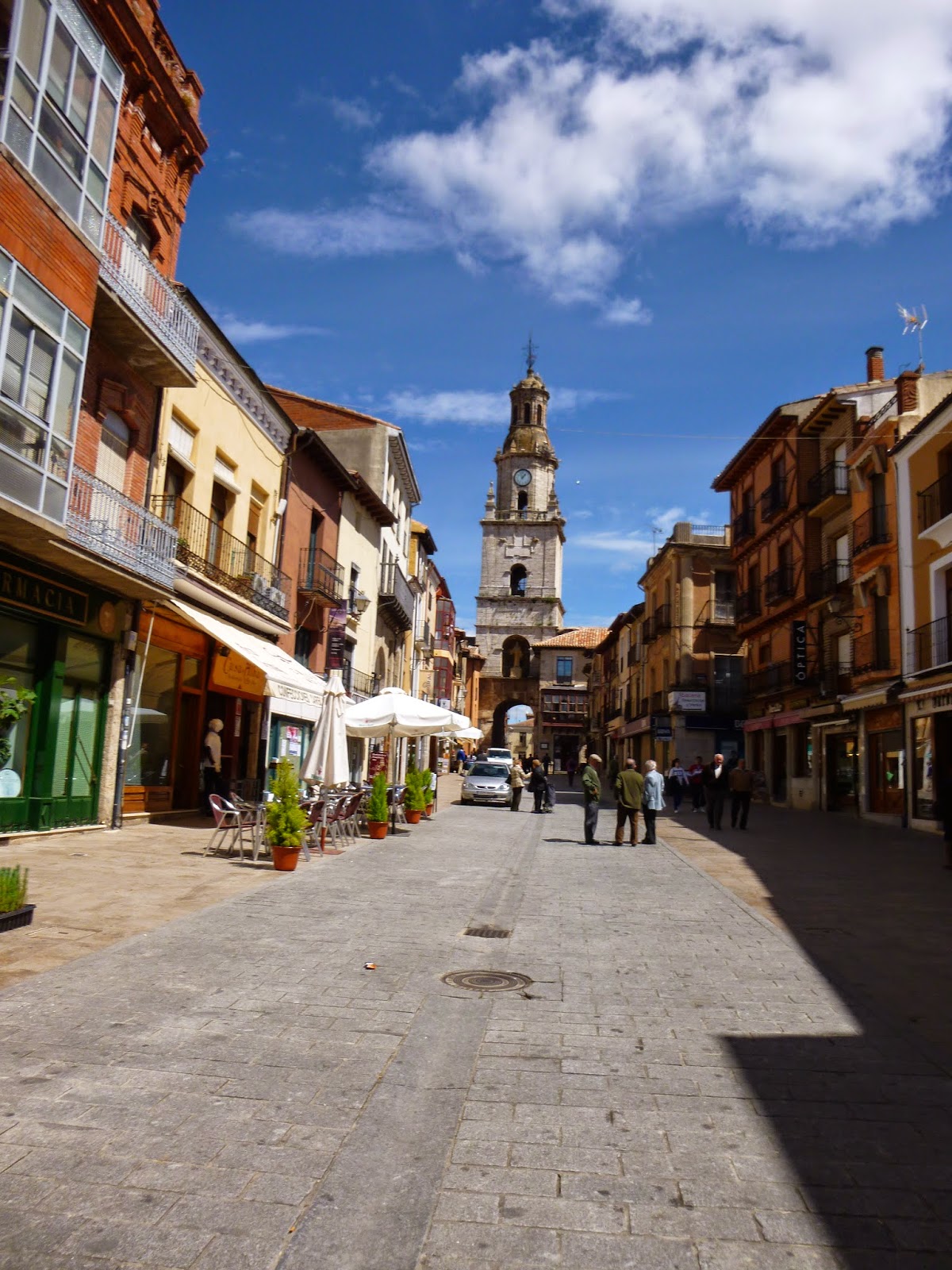
People out and about.

The arch made with wine,
which may account for
its color.

The other arch. Presumbably
not made with wine. 
After that, it seemed time to go, as there was a long drive home to Galicia and our part of Galicia. But it was a day well spent, and we were so glad that we had decided to take this little side trip on such a beautiful day. 

I  hope you enjoyed this little peek into this area of Spain. The next posts will still be about the earlier weeks in Galicia, before our trip to Braga, Portugal; and then I will follow up with pictures and posts about Braga, a most remarkable and wonderful city.

Till then, please leave a comment, and if you have any questions, I'll try to answer them. Also, if you have any additional information for us about Toro, please leave it. The turism office was closed that day, and there isn't an awful lot on line about this beautiful town.

Wednesday, May 15, 2013

An Overdue Post About Tui, Spain

A side street in Tui

Since we returned from Galicia last October, revisions, dog problems, and health issues in my god-family interrupted my posting about the trip. Because of our dog's age-related condition we are staggering our trips this year, and it occurred to me it's time to finish the post I promised: the trip to Tui, pronounced "Twee". (My husband just came back from his trip to Galicia two and a half weeks ago, and I'm leaving for my trip June 8th. I'll be posting while I'm there, though.)

But—returning to the trip to Portugal last fall—we spent an afternoon in Tui with our friends, David and Terri, on the way back from Porto. Porto, a bay city and a port, is on the Río Douro (the Portuguese name for Río Duero in Spanish); Tui is on the Río Minho (the Portuguese name for Río Miño, and pronounced the same way.) The Río Minho partially divides Spain from Portugal. (You can see a map of the Iberian Peninsula and the Río Minho HERE ).

Walking around Tui
Typical balconies
One view of the Cathedral.
 As is always the case in Iberia, it was a lovely drive from one city to the other. Once we reached Tui, we parked and spent the afternoon walking around. Tui is a cathedral town, as well as an old fortress town from the 12th and 18th centuries. The original city was enclosed by a crenelated stone wall. We started at the old quarter that clusters around the huge cathedral and ancient hospital for the poor (as well as for the peregrinos, or pilgrims—Tui is one of the pilgrim stops on the way to Santiago de Compostela). The cathedral was started in the 12th century and finished in the 17th century, and thus reflects a variety of architectures. It also has a cloister. And the front entrance, the portal, is truly awesome with fantastic stone statues of saints:

                   
Then we walked from the cathedral area with its adjoining buildings, down to the river, which was smooth as glass. The river walk along the Río Miño turned into a series of reflected scenes, as if on a mirror. On the opposite side was the ancient fortress city of Valença (pronounced Valensa) in Portugal. You can see we had good weather that day.
                                                                                           

There was also a small exercise park at one point; a "playground for seniors". And then, just as we thought we were coming to a dead end, we saw a road going back up to the Cathedral. By that time, we were all hungry, and David found a charming cafe (A Muralla) that overlooked another street and had outdoor tables covered by awnings, from which you could also see across to Portugal. (A nice view of the balcony section of the restaurant can be seen at A Muralla, Tui - Opiniones de restaurantes - TripAdvisor.) The food was delicious. And a very nice waiter took our picture before we left.

Senior playground?
                                                       
Starting back to the old quarter

A great end to the afternoon!
I hope you enjoyed this little taste of Tui. (Tui is in Galicia, in the province of Pontevedra.) I am always so amazed by the ancient stone buildings, the sculpture work, and the general architecture, that I see in that region. But I suspect much of Europe is like that.

For those of you who have traveled to other parts of Europe, I'd be interested in similarities or differences you've noticed in the places you've visited.


Friday, March 1, 2013

Return to Portugal

A city of cathedrals
Porto from the river.
An amazing wine shop/bar.


It's time for Portugal again. Our dog has improved. My godfather's health is improving. And now I'm ready to return to O Porto, albeit only in memory and in pictures.


For those of you who lost the thread of that journey, on our fall trip to Galicia my husband and I went with friends Terri and David to the old city of Porto, for three days and two nights. Porto is like an aging beauty queen: Despite the make-up and glittery clothing of main streets and the wharf side cafes and shops, you can see the "wrinkles" on back streets. But Porto has an air of grandeur, of lost days of glory still sparkling on tiled walls and statues, on the gleaming waters of the Rio Douro where boats bob on rippling water and reflections of colorful buildings on the far bank shimmer below on the wet surface. Just writing about it brings it all back. You can see why:

A city of statues.

The wharf-side

A back street.
The far bank.

You can scroll back to read the earlier post about our first day there and where we stayed. And also the fabulous restaurant where we ate: O Forno (which means "the oven"). Also, in the earlier post you can see the lovely tile work of our hotel and the wonderful garden grounds.

The second morning, when we headed out to sightsee, we noticed a school across the street, and several young girls were crowded at the window, waving at us. Then the teacher must have told them to sit down, because a moment after the picture below, they all vanished.

On our way to the wharf, we passed the wine shop you see above, at the beginning of this post, and again below. The owner is from Brazil. The shop was absolutely tiny, with a small bar that would seat four at most, and the shelves were lined with every kind of bottle of wine you could imagine. We stopped by on the way back and enjoyed a glass of port. I am not really a port drinker, but it was good to try. After all, Portugal is the inventor of port.

Rajan photographing the wineshop.

School of curious girls.

On our way up the river.
Once we got to the wharf, we could not resist the call of the river. So we boarded a boat for an hour-long river cruise.


And what wonderful sights we did see! Below are just a few samples.

Leaving the wharf.


I love the woods behind buildings.


A hidden castle in those woods.
So much color!
Awesome bridge for sure.


 For every one of these, we have oodles more. It was a splendid sight up and down the river.
A truly grand view.


Two rather interesting boats, we thought.


With the wind rippling against our faces and the smell of freshness surrounding us, once we returned to land, we were hungry. So we ate at a charming little restaurant with great atmosphere at the wharf—its name eludes me, alas.


The restaurant.
Our server.

The atmosphere.
 And then we walked around the city some more, before going home. Later, of course, we ventured out to eat a late supper. And then the next morning we left so that we would have time to stop in the city of Tui on the Spanish side of the Rio Minho (Portuguese) or Rio Miño (Spanish). Tui, in Spain, is an old castle town with a huge cathedral, and is across the river from Valença, an old fortress town in Portugal. But that will have to be for another day.

Meanwhile, I hope you enjoyed this little (and limited) trip to Portugal.